
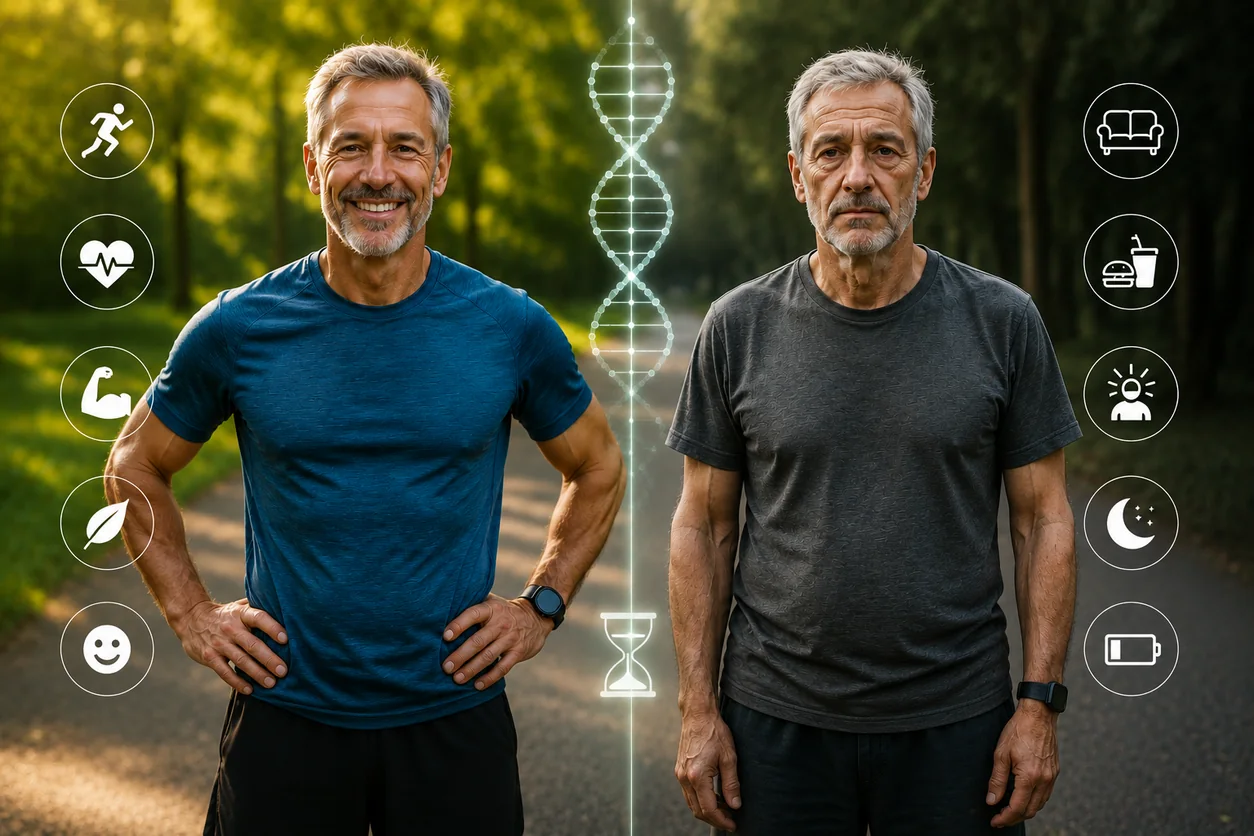
If you have a twin, you have probably heard it your whole life: "You look exactly the same." But imagine the same person meeting you both again twenty years later and suddenly saying: "Hang on — you don't seem to have aged quite the same way."
You were born on the same day and share, if you are identical twins, essentially the same DNA sequence. Yet fitness, body composition, mobility, and other biological markers can develop differently when life takes different directions.
Does that mean exercise makes one twin biologically younger? It is not that simple. Twin research shows measurable differences between some long-term more and less active twins, but it gives no single age number and does not prove that exercise stops or reverses ageing.
Quick answer
Can long-term exercise differences cause identical twins to age at different biological rates?
Twin research shows measurable differences in fitness, body composition, and certain health markers between long-term more and less active identical twins. However, a verified DNA methylation age study found no clear difference between activity-discordant co-twins. The research shows associations, not proof that exercise stops or reverses ageing.
Key takeaways
- Chronological age is the time since birth; biological or functional age is an umbrella term for several different measures, not a single definitive answer.
- In small studies of activity-discordant identical twins, more active co-twins have had better fitness and differences in body composition and certain health markers.
- The verified study of DNA methylation age found no clear difference between long-term more and less active co-twins.
- The studies do not show that exercise stops ageing, reverses biological age, or guarantees that twins will age differently.
- Function, fitness, and body composition may be more concrete and useful to describe than an appealing but uncertain "biological age number".
Is age just a number?
Chronological age is simple: it counts the time since you were born. Twins have the same birthday and therefore the same chronological age.
The calendar does not, however, say how fast someone climbs stairs, what their fitness level is, or what their body composition looks like. Two people of the same age can differ clearly in such functional and biological measures.
That does not mean chronological age is unimportant. It means ageing can be described on several levels — and that each level requires its own measure.
What is biological age?
"Biological age" is used for various models that try to summarise how the body functions or changes compared with chronological age. The models can be built on entirely different data: physical function, blood markers, organ measurements, or molecular markers.
There is therefore no universal biological age number that all researchers measure in the same way. Fitness, muscle strength, and body composition can describe functional aspects of ageing, while DNA methylation age is a specific molecular research measure.
A person may rank better on one measure and worse on another. The article therefore uses the concept as a cautious entry point, not as a diagnosis or precise age calculation.
Why twins are particularly interesting
Identical twins share essentially the same DNA sequence and often much of their early environment. When they later develop different activity habits, researchers gain an unusual opportunity to compare people with a very similar genetic starting point.
The difference between co-twins can make certain lifestyle associations more visible than in a comparison between unrelated people. At the same time, twins do not live identical lives. Work, illness, sleep, diet, stress, and many other factors can develop differently.
The twin design therefore reduces some uncertainties but does not remove them. Nor does it turn an observational study into a randomised experiment.
What the research actually shows
The 2022 review summarises findings from 17 rare Finnish identical twin pairs with long-term differences in activity levels. In the reviewed pairs, the more active twins had higher physical capacity and less total body fat, abdominal fat, and liver fat.
The FITFATTWIN study from 2015 examined 10 male identical twin pairs aged 32–36. In this small, selected sample, the more active twins had better fitness, less body fat, and differences in certain glucose-related markers, among other things.
The results show that genetically very similar people can differ in several measurable characteristics when their long-term activity habits differ. They do not show that researchers measured a single biological age number or that activity alone created every difference.
What the research does not show
The studies do not show that exercise definitively slows ageing or makes a person biologically younger. Nor do they show that a less active twin automatically ages faster.
The verified sources do not support writing that exercise directly prevents dementia, cancer, or cardiovascular disease in these twin pairs. They also did not measure a complete chain from exercise to inflammation, mitochondria, and a longer life.
A strong visual or functional contrast between a pair is easy to interpret as a before-and-after experiment. Research is more cautious: it describes observed differences in small and specially selected groups.

Muscle mass, fitness, and functional ageing
For the reader, functional ageing is often more concrete than an abstract age number. Can the body carry, walk, rise, recover, and do what matters in daily life?
The verified twin sources support differences in physical capacity and body composition between some more and less active co-twins. The FITFATTWIN source also supports a difference in measured fitness in its small sample.
The sources are not sufficient, however, for a broad article claim about sarcopenia, independence in old age, or the idea that a certain amount of exercise preserves muscle mass for everyone. Such claims require supplementary age- and exercise-specific sources.
Lifestyle, epigenetics, and biological markers
Epigenetics is a possible part of the broader story about how genes and environment interact, but this article does not make it the main explanation. The verified Finnish study examined a specific DNA methylation age measure.
When researchers compared 16 older twin pairs with long-term differences in activity levels, they found no clear difference in DNA methylation age between the more and less active co-twins. The authors concluded that leisure-time physical activity in adulthood had at most a minor effect on acceleration in this particular measure.
That result is important because it slows an overly simple narrative. Twins can differ in fitness and body composition without the same difference appearing clearly in every molecular "age clock".
The fun truth about ageing
Twins perhaps have the most detailed timeline of anyone: who got the first grey hair, who started holding their phone further away, and who still insists the muscle soreness is "only temporary".
Research does provide some support for what many twins already notice — the same birthday and very similar DNA do not guarantee identical function or body composition throughout life.
But it gives no scientific right to appoint the "younger" twin after a run. The calendar is shared. The bodies' stories are more nuanced.
What does this mean for twins?
If you and your twin have different activity habits, it can be interesting to follow how you feel and what you can do — without turning the comparison into a diagnosis or competition.
Research does not say that one of you has a certain biological age. It says that long-term different lives can coincide with measurable differences, even in genetically very similar people.
The most useful perspective is therefore not "who is ageing fastest?" but "which aspects of function and health can we track in a safe and meaningful way?"
The TwinPare perspective
At TwinPare we are fascinated by the moment when similarity meets life experience. Twins can start with nearly the same genetic blueprint and still become less biologically alike over time.
That is a hopeful thought, but not a promise of control. Genes, environment, illness, chance, and lifestyle habits interact in ways no single age measure can fully capture.
You cannot stop time. Research does suggest, however, that functional characteristics and body composition cannot be read solely from a birth date or a DNA sequence.
Source and limitations
The article uses three verified sources. The 2022 review summarises findings from 17 long-term activity-discordant identical twin pairs. The FITFATTWIN study from 2015 covered 10 male identical twin pairs aged 32–36. The epigenetics study from 2019 analysed DNA methylation age and a small co-twin group of both identical and fraternal pairs.
The sources support cautious claims about differences in physical capacity, fitness, body composition, certain glucose-related markers, and the specific methylation age measure.
They do not prove that exercise stops or reverses ageing, that a twin receives a certain biological age, or that all long-term active people get the same result. The small, observational, and selected samples limit generalisability.
Claims about sarcopenia, inflammation, mitochondrial function, dementia, cancer, cardiovascular disease, and precise ageing rate require additional verified sources. They are therefore not used as direct conclusions in the article.
Source notes
The sources have been verified and editorially reviewed for this article. The limitations below show which level of conclusion the sources support.
- [kujala-2022] Physical activity and health: Findings from Finnish monozygotic twin pairs discordant for physical activity. Urho M. Kujala; Tuija Leskinen; Mirva Rottensteiner; Sari Aaltonen; Mika Ala-Korpela; Katja Waller; Jaakko Kaprio. Scandinavian Journal of Medicine & Science in Sports, 2022. Evidence type: Peer-reviewed summary of findings from 17 identical twin pairs with long-term differences in physical activity levels Limitation: The reviewed sample consists of 17 rare identical twin pairs with long-term differences in physical activity. The design is informative but small, and cannot make every observed difference universally causal or guaranteed. PubMed PMC DOI
- [rottensteiner-2015] Physical activity, fitness, glucose homeostasis, and brain morphology in twins. Mirva Rottensteiner; Tuija Leskinen; Eini Niskanen; Sari Aaltonen; Sanna Mutikainen; Jan Wikgren; Kauko Heikkilä; Vesa Kovanen; Heikki Kainulainen; Jaakko Kaprio; Ina M. Tarkka; Urho M. Kujala. Medicine & Science in Sports & Exercise, 2015. Evidence type: Cross-sectional co-twin control study of 10 activity-discordant male identical twin pairs aged 32–36 years Limitation: The small, selected sample showed differences in fitness, body fat, and some glucose-related markers. The study was observational and did not measure a composite biological age. Results cannot be generalised to all twins, sexes, or ages. PubMed DOI
- [sillanpaa-2019] Leisure-time physical activity and DNA methylation age-a twin study. Elina Sillanpää; Miina Ollikainen; Jaakko Kaprio; Xiaoling Wang; Tuija Leskinen; Urho M. Kujala; Timo Törmäkangas. Clinical Epigenetics, 2019. Evidence type: Twin cohort and co-twin control analysis of DNA methylation age, including younger and older Finnish twins and 16 long-term activity-discordant older pairs Limitation: The study examined a specific DNA methylation-based age measure. In the co-twin analysis of seven identical and nine fraternal pairs, no clear difference was observed between active and inactive co-twins. The authors concluded that leisure-time physical activity in adulthood had at most a minor effect on acceleration in this measure. PubMed PMC DOI
Editorial source review
This section shows how the article's key factual claims are linked to the source.
Phrasings that require caution
- Write that twins may differ in functional and biological markers, not that exercise definitively changes their biological age.
- Call biological age an umbrella concept with several possible measures, not a single objective answer.
- Describe the active twins' findings as observed differences in small, selected samples.
- Write that the methylation study found no clear co-twin difference and at most a minor effect on the studied measure.
- Do not claim that exercise stops, slows, or reverses ageing.
- Do not link sarcopenia, inflammation, mitochondria, dementia, cancer, or cardiovascular disease to the article without additional verified sources.
| ID | Claim | Source support | Caution |
|---|---|---|---|
| C1 | DNA methylation age is a specific biomarker-based measure and not a complete summary of a person's biological age. | 2019 | Clearly distinguish between a single research measure and the broader, contested umbrella concept of biological age. |
| C2 | Activity-discordant identical twin pairs enable co-twin comparisons with a largely shared genetic background. | 2022 , 2015 | Do not write that the design fully isolates the effect of exercise. |
| C3 | In the review of 17 long-term activity-discordant identical twin pairs, the more active co-twins had higher physical capacity and less fat in several studied depots. | 2022 | Tie the result to the reviewed pairs and the small, rare sample. |
| C4 | In the FITFATTWIN sample of 10 young adult male identical twin pairs, differences in fitness, body fat, and certain glucose-related markers were observed. | 2015 | Do not generalise to all twins, women, or older people, and do not imply causation. |
| C5 | The used twin sources support differences in physical capacity, fitness, and body composition in the studied pairs. | 2022 , 2015 | Call these functional and physical measures, not evidence of a slower overall rate of ageing. |
| C6 | The co-twin analysis found no clear difference in DNA methylation age between long-term more and less active co-twins. | 2019 | Do not reframe a null result as a claim about rejuvenation or slowed ageing. |
| C7 | The three sources describe several separate measures and cannot be combined into a precise biological age number or a causal promise. | 2022 , 2015 , 2019 | Keep this limitation visible before the source notes and the publication decision. |